Hard and soft woods
There is a solid connection between the properties of wood and the properties of the specific tree that yielded it. For each tree species there is a scope of thickness for the wood it yields. There is a harsh relationship between's thickness of a wood and its quality (mechanical properties). For instance, mahogany is a medium-thick hardwood. It is amazing for fine furniture creating, making it helpful for demonstrate building. The densest wood might be dark ironwood.
It is regular to group wood as either softwood or hardwood.
a) The wood from conifers (e.g. pine) is called softwood.
b) The wood from dicotyledons (typically expansive leaved trees, e.g. oak) is called hardwood.
These names are somewhat deceptive, as hardwoods are not really hard, and softwoods are not really soft. The notable balsa (a hardwood) is really softer than any business softwood. On the other hand, some softwood (e.g. yew) are harder than numerous hardwoods.
Shading
A few animal types demonstrate an unmistakable distinction amongst heartwood and sapwood. In these species, normal shade of heartwood is darker than that of the sapwood. Frequently the differentiation is prominent. This is created by affidavit of compound substances in the heartwood. A sensational shading contrast does not mean an emotional distinction in the mechanical properties of heartwood and sapwood. A few examinations on extremely pitch( us Longleaf Pine examples show an expansion in quality, because of the gum. It builds the quality when wood is dry. Such gum sat irated heartwood is called fat lighter. Structures worked of fat lighter are r Dt assaulted by termites. Be that as it may, they are extremely combustible. Stumps of old ilngleaf pines are frequently delved and part into little pieces. These are sold as fuel for flames. Stumps along these lines burrowed may really remain a century or more since being cut. Anomalous staining of wood frequently means a sick condition, demonstrating unsoundness. The dark check in western hemlock is the aftereffect of creepy crawly assaults.
Structure
Wood is a heterogeneous, hygroscopic, cell and anisotropic material. It is made out of cells. Theircell dividers are made out of smaller scale fibrils of cellulose (40% — half) and hemicelluloses (15% — 25%) impregnated with lignin (15% — 30%). The cells are for the most part of one kind, tracheids. They are considerably more uniform in structure than that of generally hardwoods. There are no vessels ("pores") in coniferous wood, for example, one sees so noticeably in oak and powder. The structure of hardwoods is more mind boggling. The water directing capacity is relies upon vessels. Sometimes (oak, chestnut, cinder) vessels are very substantial and particular. Be that as it may, in others (buckeye, poplar, willow) it is too little to be seen without a hand focal point. Such woods are partitioned into two substantial classes, ring-permeable and diffuse-permeable.
- -
- -
a) Ring permeable animal varieties:. In ring-permeable species, the bigger vessels
or, then again pores are limited in the piece of the development ring shaped in spring. In this way they frame a district of pretty much open and permeable tissue. Whatever is left of the ring, created in summer, is comprised of littler vessels. It is made out of significantly more prominent extent of wood strands. These fiber are the components which give quality and durability to wood. In any case, the vessels are a wellspring of shortcoming. Such wood is available in fiery remains, dark beetle, catalpa, chestnut, elm, hickory, mulberry, and oak,
b) Diffused permeable woods: For this situation, the pores are equitably measured. Along these lines, water directing capacity is scattered all through the development ring as opposed to being gathered in a band or column. Cases of this sort of wood are basswood, birch, buckeye, maple, poplar, and willow. Halfway gatherings: Some species, for example, walnut and cherry, are on the outskirt between the two classes, framing a middle gathering.
Early wood and latewood in softwood
In calm softwoods there frequently is a stamped distinction amongst latewood and early wood. The latewood will be denser than that .framed right on time in the season. At the point when analyzed under a magnifying instrument the cells of thick latewood are thick-walled. They have little cell depressions. Yet, those shaped first in the season have thin dividers and huge cell depressions. The quality is in the dividers, not the pits. In this manner there is more prominent the extent of latewood the more noteworthy the thickness and quality. In picking a bit of pine the central thing to watch is the similar measures of early wood and latewood. The width of ring is not almost so critical as the extent and nature of the latewood in the ring.
an) Early v promotion and latewood in ring-permeable woods: For the situation of
the ring-permeable hardwoods there appears to exist a truly unequivocal connection between the rate of development of timber and its properties. By and large, if there is more quick development or the more extensive the rings of development, the heavier, harder, more grounded, and stiffer the wood. This, it must be recalled, applies just to ring-permeable woods, for example, oak, fiery remains, hickory, and others of a similar gathering, and is, obviously, subject to a few special cases and restrictions.
b) Earlywood_and latewood in diffuse-permeable woods: In the
diffuse-permeable woods, the boundary between rings is not generally so clear. Sometimes, it is practically (if not by any stretch of the imagination) imperceptible to the unaided eye. On the other hand, when there is an unmistakable outline there may not be a perceptible distinction in structure inside the development ring. In diffuse-permeable woods, the vessels or pores are even-sized, with the goal that the water leading capacity is scattered all through the ring rather than gathered in the early wood. The impact of rate of development is, in this way, not the same as in the ring-permeable woods, moving toward all the more about the conditions in the conifers.
Monocot wood
Some auxiliary material generally looks like common, dicot or conifer wood. These are delivered by various monocot plants. These additionally are called wood. Its illustration is bamboo. It is an individual from the grass family. It has impressive financial significance. Vast culms are generally utilized as a building and development material. Another real plant assemble is called wood are the palms. Of considerably less significance are plants, for example, Pandanus, Dracaena and Cordyline. With this material, the structure and arrangement of the auxiliary material is very unique in relation to conventional wood.
10. Water content
Water happens in living wood in three conditions, in particular: I. In the cell dividers
In the protoplasmic substance of the cells.
As free water in the cell pits and spaces.
In heartwood it happens just in the First and last structures. Wood that is completely air-dried holds from 8-16% of water in the cell dividers. The stove dried wood likewise holds a little level of dampness. The water substance make the wood softer and more flexible. A comparative impact is in the softening activity of water on paper or fabric. Inside specific restrains, the more noteworthy the water content, the more prominent its softening impact.
11. Employments of wood
1. Fuel: Wood has a long history of being utilized as fuel. It is stills utilized as fuel in provincial ranges of the world. Hardwood is favored er softwood since it makes less smoke and consumes longer.
Development: Many structures are made and embellished with wood. Wood is an imperative development material. Wood stays in like manner utilize today in watercraft development. Wood to be utilized for development work is generally known as timber in North America. Somewhere else, stumble is called as felled trees. New household lodging in many parts of the world today is ordinarily produced using timber-confined development. Built wood items are turning into a greater piece of the development business. They might be utilized as a part of both private and business structures as basic and tasteful materials. In structures made of different materials, wood will in any case be found as a supporting material. It is particularly utilized as a part of rooftop development, in inside entryways and their edges, and as outside cladding. Wood is likewise ordinarily utilized as covering material.
Built wood: Wood utilized as a part of development incorporates items, for example, stuck overlaid timber (glulam), covered polish timber (LVL), parallam and I-joists. These items permit the utilization of littler pieces. They may likewise be chosen for particular ventures, for example, open swimming pools or ice arenas Wood won't fall apart within the sight of specific chemicals. These designed wood items are all the more ecologically amicable. They are some of the time less expensive, than building materials, for example, steel or solid.- Wood unsatisfactory for development is separated mechanically (into filaments or chips) or synthetically (into cellulose). It is utilized as a crude material for other building materials, for example, chipboard, built wood, hardboard, medium-thickness fiberboard(MDF), situated strand board (OSB). Such wood subsidiaries are generally utilized. Wood filaments are an imperative segment of generally paper. Cellulose is utilized as a segment of some engineered materials. Wood subsidiaries can likewise be utilized for sorts of deck, for instance cover flooring.
Cutting edge wood items: Further advancements incorporate new lignin stick applications, recyclable sustenance bundling, elastic tire substitution applications, against bacterial restorative operators, and high quality textures or composites. As researchers and designers additionally learn and grow new methods to extricate different segments from wood.
Furniture and utensils: Wood has dependably been utilized broadly for furniture, including seats and beds. Additionally for apparatus handles and cutlery, for example, chopsticks, toothpicks, and different utensils, similar to the wooden spoon.
In expressions of the human experience: Wood has for quite some time been utilized as an aesthetic medium. It has been utilized to make figures and carvings for centuries. Illustrations incorporate the chain of commands cut by North American indigenous individuals from conifer trunks. Certain sorts of melodic instruments, for example, those of the violin family, the guitar, the clarinet and recorder, the xylophone, and the marimba,
Heartwood and sapwood
Heartwood and sapwood
a) Heart wood: Heartwood (or “xylem”) is wood that as a result of tylosis become more resistant to decay. Tylosis is the deposition of chemical substances (a genetically programmed process). Once heartwood formation is complete, the heartwood is dead. Some uncertainty still exists as to whether heartwood is truly dead, as it can still chemically react to decay organisms. Usually heartwood looks different; in that case it can be seen on a cross-section. Heartwood may (or may not) be much darker than living wood. It may (or may not) be sharply distinct from the sapwood. However, other processes, such as decay, can discolor wood, even in woody plants. The term heartwood derives from its position and not from any vital importance to the tree. A tree can thrive with its heart completely decayed.
b) Sapwood: Sapwood is the younger, outermost wood. In the growing tree it is living wood. Its principal functions are to conduct water from the roots to the leaves. It also store up and give back aecording to the season the reserves prepared in the leaves. All xylem tracheids and vessels have lost their cytoplasm and the cells are therefore functionally dead in sapwood. All wood in a tree is first formed as sapwood. The more leaves a tree bears and the more vigorous its growth, the larger the volume of sapwood required. Hence trees making rapid growth in the open have thicker sapwood for their size than trees of the same species growing in dense forests. Sometimes trees grown in the open may become of considerable size, 30 cm or more in diameter, before the formation of heartwood. Some species begin to form heartwood very early in life. Therefore, they have only a thin layer of live sapwood. But in others the change comes slowly. Thin sapwood is characteristic of such species as chestnut, black locust, mulberry, osage-orange, and sassafras. But it is thick in maple, ash, hickory, hackberry, beech, and pine. Some others never form heartwood.
THE WOOD
CHARACTERISTICS OF WOOD
Wood is a I–41 fibrous tissue found in many plants. It has been used for centuries ice noth fuel and as a construction material. It is composed of 2 natural composite of cellulose fibers (which are strong in tensio .) embedded in a matrix of lignin. Lignin resists compression. W md is produced as secondary xylem in the stems of trees. In a living tree it transfers water and nutrients to the leaves and other growing tissues. It has a support function, enabling woody plants to reach large sizes or to stand up for themselves.
- Formation
Wood is yielded by trees. A tree increases in diameter by the formation of new woody layers between the existing wood and the inner bark. It envelops the entire stem, living branches, and roots. Technically this is known as secondary growth. Secondary growth takes place by the cell division in the vascular cambium, a lateral meristem, and subsequent expansion of the new cells.
- Growth rings
In some areas like Pakistan, there are clear seasons. Here growth can occur in a discrete annual or seasonal pattern, leading to growth rings. These rings can be clearly seen on the end of a log. These are also visible on the other surfaces. If these seasons are annual these growth rings are called as annual rings. Where there is no seasonal difference growth rings may be indistinct or absent. In some cases, there are differences within a growth ring. Wood is divided into two types on the basis of type of growth rings:
a) Early wood or springwood: The part of a growth ring nearest
the center of the tree arc formed early in the growing season. Growth is rapid during these seasons. They are composed of wider elements. It is lighter in color than that near the outer portion of the ring. It is known 3S early wood or springwood.
h) Late wood or summer wood; The outer portion formed later in the season is then known as fir: latewood or suminerwood.
- Knots
A knot is a particular type of imperfection in a piece of wood. It will affect the technical properties of the wood. It makes the wood imperfect. But knots may be exploited for artistic effect. In a longitudinally sawn plank, a knot will appear as a roughly circular solid piece of wood. The grains of the rest of the wood flow around this piece of wood. Within a knot, the direction of the wood (grain direction) is up to 90 degrees different from the grain direction of the re ular wood.
Natural Planting

Only the brilliant red flowers at forest's edge were planted by us. Everything else is here with no human action of any kind for many years. The area was plowed as a field or used as cow pasture in the distant past. The Cardinal Flower may naturally reproduce in this location since we searched for a spot that had everything that this plant requires. An occasional spring seeps water into this area. The shade of the bedrock ridge delays the arrival of warm days as winter ends. Late snow cover may help these plants avoid the ravages of bitter frosts. We will likely find eighteen daughter plants growing where these three plants grew. As next summer builds we will look for new plants from seed that may appear as a result of this moist ground. We find those prospects exciting.

This is one of the recently discovered new plants from seed. They were placed in pots to see how they responded to being ripped from the ground. A shaded location and frequent watering have them in excellent condition. Fall transplants usually do not survive here but these plants have considerable time to put down roots in their new location.

This is hardly a natural looking location but we are doing everything possible to help these plants survive and reproduce on their own. This is river-bottom ground and it is much warmer here than up the hill. River fog frequently washes away frost before it has a chance to really form and damage plant leaves. That should lessen the impact of frost on these plants. Stones store both heat and moisture. Cardinal Flower requires both to survive. A little work on the driveway will divert rainfall runoff in the direction of these plants. Partial shade from the nearby sumac trees will make this a more gentle location.

These three times chopped leaves finished the planting. Their job is to smother weeds, retain moisture and decay into a more natural woodland soil.
The triangular shaped rock and I have a history. The farmer working the land that borders ours places stones removed from the field on the aged stone wall that serves as a boundary. A huge visually interesting rock was part of the newly dropped stones. Despite the landowners permission for us to harvest stone here, there was no way that this stone could be moved. Hammer and wedges split the stone into several slices. This top piece was walked up the hill to the gravel bank. That journey required several days since my periods of hard physical exertion must be limited to avoid cardiac episodes. Several flip overs moved this stone to the top of a temporary wall. Today the stone was easily moved down into the lawn cart. The final move was accomplished easily. The stone will last for years and we hope that the Cardinal Flower can survive in this location.
The area behind the stones is scheduled to be transformed into a no care planting of native plants. The first New England Aster is in place. It will be joined by Black Eyed Susans, Anise Hyssops and more asters. First we need to beat back the invasive field grasses. That task needs to be completed soon or our new natives will simply be overrun.
Pictured Exactly As Found

These cast off remains of a likely coyote kill were in the path I use to get to the gravel bank. The stomach and intestines hold no interest for the predators. Size suggests that the victim might have been a deer. Investigation in the brush filled area near the entrails might have revealed bones or hair where the pack tore their victim apart. Good common sense dictates no exploration of the area near a fresh kill.

In the past a snake appearing creature was found in the grass. It was a dead snake covered with carrion beetles. These dead parts were left where they were to see just what animals will feed here after the pieces lie in the sun for a day or two. If we get another opportunity to see carrion beetles, pictures will follow. If nothing shows any interest in these pieces they will be buried.
When we were younger and somewhat more foolish, outside after dark was a common occurrence for us. Seeing coyotes altogether too close and chance encounters with surprised skunks have led us to surrender the night to the animals. We will venture out if necessary but essentially remain indoors after dark Night trips outside usually feature us talking rather loudly to ourselves not because we are losing it but because we do not want to surprise any creatures of the night. If they hear us coming, we are usually given a free pass.
Two days after these pictures were taken all of the pieces remained in the path untouched and unmoved. Four days after these pictures were taken no sign of these body parts remained. Even small pieces of the broken intestine were gone. We missed the cleanup crew but suspect that either crows or vultures were responsible.
Sex Among Flowers
Most of our efforts focus on just keeping the wild flowers here alive. We aim for their reproduction to follow its natural course with no help from us but to date the actual results have been disappointing. For the past several years attempts have been made to see Trailing Arbutus plants with fresh pollen. So far all that we have managed to see is old pollen tracked across the white surface of the flowers. It seems that the fresh pollen exists for only a moment. We know with absolute certainty that their pollination was successful since numerous seed clusters formed each year. Today for the first time we stumbled upon the fertilization moments of Cardinal Flower.

We brought a loupe into the garden this morning. It revealed detail that we never knew existed despite the many hours over several years that we spent looking at these flowers. We knew that the white speck existed but we did not know that it resembled a neatly trimmed beard.
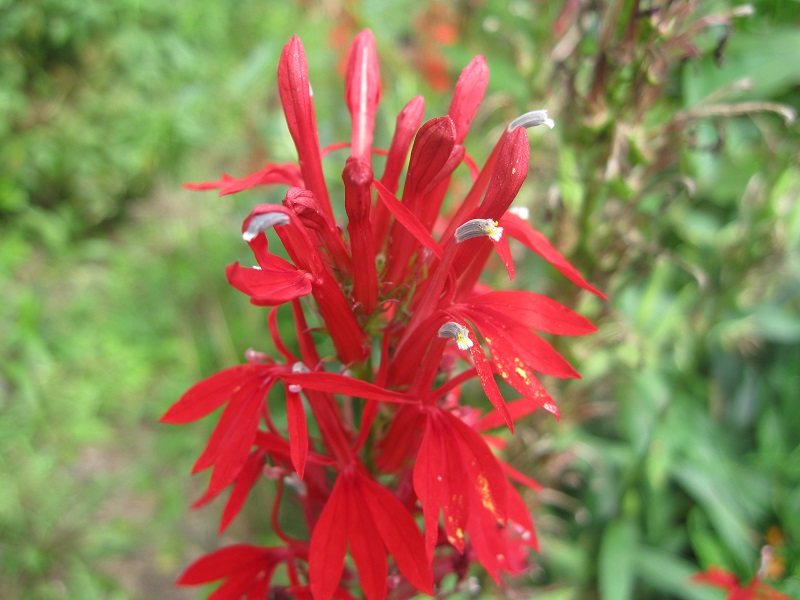
Yellow pollen stains on red flower petals were easily seen with the naked eye. Magnification clearly revealed that the white beard hairs were now covered with pollen grains. We were seeing both the filament and the anther producing and holding pollen.

What came next took us completely by surprise. The pollen gathering stigmas began to push their way past the pollen bearing male parts.

Here the male beard seems attached to several protruding stigmas. Wasted pollen litters a red flower petal.

Several fully exposed stigmas can be seen pushed well past the former location of the anthers.

Another plant displays similarly exposed pollen gathers.
We checked back later in the day to see what if anything was going on with the Cardinal Flowers. No trace of the fertilization process pictured here could be found. Both the stigmas and their styles had been pulled back into the flower destined to send their pollen load to the ovaries located in the base of the bud wrappers. Some dried anther hairs hung from the outside of the hollow tubes.
All of this drama will be repeated among younger flowers waiting to open on another day. The process ends rather quickly and it is easy to miss completely. It appears possible that the entire fertilization process is completed within each individual blossom. Hummingbirds are widely credited as Cardinal Flower pollinators but what was captured here today did not need anything external to the flowers. We will continue to watch and perhaps learn. In our location the main problem remains. What can be done to improve the germination rates of the thousands of seeds we saw created today?
Batterson Bower

We presently have more garden than we can properly care for so the creation of more might be difficult to understand. A no care woodland space filled with mostly native plants is our goal here. Since the young sumac trees have not been growing here very long, soil from our woods and bags of fallen leaves were trucked in to rot down creating a natural woods soil.
Batterson is the surname of the family that operated an inn here in the distant past. Their business came from travelers making the trek from Sidney to Gilbertsville. The railroad came up the other side of the valley and Mr. Batterson built a bridge across the river in an attempt to keep his inn afloat. A nearby pine covered picnic area on the bank of the Unadilla River was a popular outing destination. The Batterson Inn was just a short walk away and he could sell food to those enjoying a day nearby. Batterson Crossing is still recognized as the name of this spot despite the removal of the bridge almost 40 years ago. We respectfully borrow their name for our developing garden in the dappled shade.

The large stone is intended to serve as a water source for the moisture craving bunchberry. Warm stones gather moisture from cool night air so the area around the stone will be more moist. The stone was also placed to divert rainfall but that water will drain away from the bunchberry. Those plants were placed so that they were in full view. They can always spread toward the wetter soil.

This is the view looking to the west. Our neighbor's well tended former field begins where our sumac trees end. A strip of bark mulch will be installed as a barrier for his grass. It will need to be weeded and renewed but it will be effective in controlling the naturally spreading grass.
The stones in the foreground are in storage. They will be placed to define planting areas that at least suggest a natural setting. The bags of leaves await their trip through the mower.

There are four plants that we placed in this area. The larger two plants with spotted leaves was gifted to us under the name trout plant. It is actually a Pulmonaria native to Europe. It has no proper place in a native plant garden but is a well behaved alien. Its flowers open pink colored then turn to purple. How neat is that? The spotted leaves look good for months. It is hardy and spreads generously but does not claim large areas for itself.
Foamflower is a native that grows in our back woods. Three newly purchased specimens complete the planting under this cluster of sumac trees. Foamflower is described as a spreading ground cover but that is not its habit in our dry woods. We will watch and wait to see how it grows in this location.
The leaves were collected last fall and have been stored in their plastic bags. Two trips through our hand mower has produced a fine mulch that will not blow into our neighbor's lawn. A winter under the snow pack will reduce these bits of leaves to a dark rich looking soil that could have come from a forest. We will renew the leaf mulch in the spring to smother unwanted weeds. For now we really like the way this looks.
Exceptional Clarity

We were walking about where the remains of the bedrock ridge dip into glacial gravel deposits. This area is unique in the natural cycles that play out here. Huge quantities of snow melt water pour into this area but no signs of surface runoff are ever seen. Water stained snow works its way across some of the meadow but never reaches the point of sharply lower ground.
Three Cardinal Flower plants were placed near an occasional spring run in the hope that these plants could reproduce here. That is a long shot at best but the attempt was free. Today we discovered a jumble of three rather large chunks of ridge stone protruding out of the ground very close to the red flowers. Gaps between those stones may allow the water to drain away keeping this spot moist but never submerged.

This picture reveals two special qualities. One is the clear brilliance of the flower color that exceeds displays in our gardens. That difference may be the result of generous soil moisture or a partially shaded location. The clear image of a single open flower is rarely seen. Flowering begins at the base of the raceme and works its way toward the top with one flower opening over the next. Here a single open flower is surrounded by buds. The buds are rather long and the seeds form deep at the base where the bud is surrounded by green. How the pollen grains travel that great distance is a puzzle but the length of a humming bird's tongue may be a factor. Three flower petals droop downward while two others resemble arms reaching toward heaven. The white tipped tube is part of the reproducing organ. There is nothing simple or easy about this plant.

Close by we found this area that is frequently flooded. The usual pernicious field grasses are naturally absent from this spot while tufts of grasses usually seen near the pond leave some open ground. This spot will receive several Cardinal Flower plants to see if they will grow here. This area is in the shadow of the ridge and the snow cover lingers here. Some natural protection from hard frosts might be found here helping the tender new growth to survive. We know that a location where Cardinal Flower can survive long term is incredibly rare but we will persist in trying to find one.
Lettuce Coming And Going

How can one garden without growing lettuce? Controlling our food supply was one of the forces pushing our early efforts in he garden. Having spent many winters reading about the lifestyle of Scott and Helen Nearing, clearly defined what I was looking for. We have their book featuring the stone greenhouse but our version never got built. We do manage to grow our own lettuce for several months of the year.
Rabbits and lettuce both growing in the same area presents predator problems. Wire fencing bent into cages is our first line of defense. Unfortunately, baby bunnies zip through the two inch wide openings like no barrier exists. Mobile home skirting was fashioned into a low wall. For many years the combination of the wall and cages have protected our plants. Once a woodchuck burrowed under the wall but found the cage array troublesome. Only temporary damage done was the yellow subsoil and stones that were left on top of my carefully made dark soil.
The old plants flowering and making seed now need to be cleared out. We make no attempt to save seed but sometimes find new plants growing at the base of the compost pile or where the previous year's crop grew. Once the lettuce bolts, the leaves become bitter.

These plants are growing one bed behind the others. It has provided us with great fresh salad material but is now largely past. A second strip of wire fencing was added around the bottom edge. Rotated 90 degrees, the openings went from 2 X 4 to 2 X 2. The young rabbits were effectively denied entrance to the tasty young plants inside but the extra wire made the cage heavy and awkward to remove. Simply placing it on edge solved that problem.

These plants will serve as our current source of fresh lettuce. The combination of a shade cover over the wire cage and the lower nighttime temperatures will keep these plants usable for a longer period of time. Composting old lettuce is unpleasant but it is part of having enough.

Here is the next generation of salad supplies. Summer heat prevents lettuce seed from germinating so these plants were started in the basement. Their potting soil was also stored in the relative cool there. Four seeds are placed in each pot and some of this day with drizzle will be used to replant with but a single plant in each pot. Holding these plants in the pots will slow their growth until they are needed in the garden. When the time is right they will be planted out and our supply of fresh greens will continue into fall. A new tray of seeds could be started now but this whole process is getting a little old. The first seeds were put to soil in March driven by my need for winter to end. Now we have no season extenders so our plants will be ended by frost. My preference is for that first frost to find my garden soil bare. What is missed from late harvests is offset by a lack of cleaning up the black slime that follows frost on plants left in the garden.
To Move Or Not To Move...

Amy and I were working to clear some of the weeds from the thyme on the patio. Things were going great, but then she spotted this gorgeous "Marge Simpson" spider otherwise known as Arigope aurantia. We both remembered these spiders as being much darker in color. We decided to leave this beautiful blonde in peace and move to another spot in the garden to work! That was several days ago and she is still right there in the middle of her web today!

A single milkweed plant is growing out of Ed's curved stone wall. I spotted this Monarch caterpillar on the plant when he was tiny. It has been great fun to look for him when passing by. The change in his size has been astounding. Of course all caterpillars really do is eat and drop frass. Leaves on the plant this morning were down to a precious few, but it was the slight tinge of yellow in the leaves that made me decide to take action.

I lopped off the plant at its base and carefully placed it against a nice green milkweed plant inside the stone square. Later I went out and checked The transfer has been made. The caterpillar switched to the new plant.

The caterpillars new home is in the foreground of this picture right between the lemon and the red basil. I hope he likes it. I think it was a fabulous move!
Subscribe to:
Posts (Atom)
Alien Invader
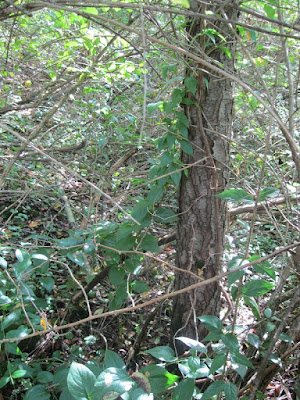
Becky recently noticed this previously unknown to us plant growing next to our driveway. Her investigation revealed that this vine is as ba...
-
Gametophytic nature: Endosperm is formed in the embryo sac by free nuclear division. Therefore, some botanists take it vegetative tissue of...
-
 Most of our efforts focus on just keeping the wild flowers here alive. We aim for their reproduction to follow its natural course with no h...
 -
Types of embryo Sac Development There we types of embryo sac development. The classification is based on: The number of 9 ses or spore n...